Opportunity for Spread Enhancement for Insurers
last updated on Thursday, August 20, 2026 in Strategies
At FHLB Des Moines, we view Advances as a flexible funding solution that can help member insurance companies enhance portfolio spreads while supporting broader balance sheet objectives. By providing reliable secured funding, Advances may enable insurers to finance higher-yielding assets and potentially earn a spread above their borrowing costs, contributing to improved portfolio diversification and additional investment income through the strategic use of leverage.
Members have utilized Advances to support investments across a range of asset classes, including mission-related assets such as Commercial Mortgage-Backed Securities (CMBS). When appropriately aligned with investment objectives and risk tolerances, these strategies can offer attractive risk-adjusted return opportunities.
Our Advance products are designed with flexibility in mind, allowing members to select from a variety of structures, including fixed- and floating-rate options, a range of maturities, prepayment features, and other embedded options that can be tailored to specific funding and asset-liability management (ALM) needs.
Historically, floating-rate Advances have been well suited to spread-enhancement strategies, particularly when paired with floating-rate assets. Adding in the ability to pay off the Advance without penalty due to call features helps the member mitigate ALM mismatches between the asset and liability. Members can utilize short- to intermediate-term Advances and may choose to refinance or roll borrowings at maturity, providing additional flexibility as market conditions and portfolio objectives evolve.
Spread Enhancement Strategy
For this example, we focus on the floating-rate Advance products offered by FHLB Des Moines. These funding structures are designed to align with current market conventions while providing members with a competitive and reliable source of liquidity. The Advances are generally indexed to Overnight SOFR, the market's primary benchmark for short-term interest rates.
On the asset side, we will use a floating-rate CMBS. Many floating-rate assets are tied to 30-day or 90-day average SOFR benchmarks rather than Overnight SOFR. While this creates a modest basis difference between asset yields and funding costs, the impact is often minimal, up to ten basis points. For more information, historical SOFR rates can be found on the New York Federal Reserve website. As a result, SOFR-based floating-rate advances can provide an effective funding match for insurers seeking to finance floating-rate asset portfolios.
The following tables demonstrate the parameters and net income of using the floating-rate CMBS Spread Enhancement Strategy. This strategy reflects purchasing AAA rated 5-year CMBS SASB floater funded with a 5-year callable FHLB Des Moines SOFR Advance. We factored in an investment management fee which can vary depending on the mandate.
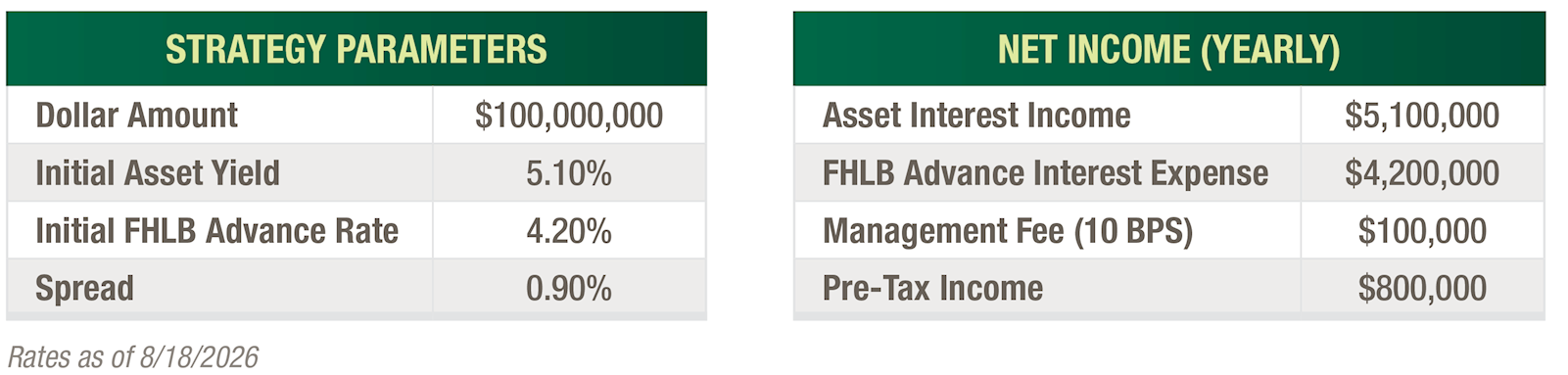
On a $100,000,000 investment, this Spread Enhancement Strategy can achieve an income of approximately $800 thousand million over the course of a year. This does not include capital charges or losses due to default or the net income of the FHLB Des Moines activity stock dividend. All these factors should be considered when evaluating the Spread Enhancement Strategy. The current value of the FHLB Des Moines Activity Stock Dividend is 9.95%1 and the activity stock requirement is 4.5% of the outstanding Advance amount.
Another consideration of the Spread Enhancement Strategy is Risk-Based Capital (RBC) charges. The RBC impact of FHLB-funded spread enhancement programs depends on several factors, including type of insurer (Life vs Property & Casualty), whether the program is well matched, and Asset Risk charges. While RBC outcomes vary by insurer and strategy, properly structured FHLB-funded spread programs can provide capital-efficient funding while remaining consistent with prudent risk management practices.
Additionally, when utilizing the Spread Enhancement Strategy to purchase mission-related assets, such as CMBS, those assets can then be pledged to the FHLB Des Moines as collateral for additional borrowing capacity. The program has the added benefit of providing collateral for future funding and liquidity needs.
For insurers, a Spread Enhancement Strategy can be an effective way to improve portfolio earnings by leveraging low-cost, secured FHLB Des Moines funding to invest in higher-yielding assets. When appropriately structured, the strategy can generate incremental income, support asset-liability management objectives, and enhance portfolio diversification.
DOWNLOAD ANALYSIS
Contact Us
For more information, please don't hesitate to reach out to relationship manager, Laura Beebe.
1 As of last dividend paid on August 11, 2026 - FHLB Des Moines does NOT project dividend payments.
TAGS
- Advances
- Insurance
- Strategies